Why Granting Raw Data Access is High Treason!
And how to address the inevitable question!

In the modern data organization, there is a constant, underlying tension. On one side, you have the Data Engineering team… the stewards of governance, reliability, and architecture. On the other, you have Data Science and Product teams, who view any delay in data access as an obstacle to innovation.
Recently, a classic scenario played out. A product team was staring down a deadline to ship a new machine learning feature for predictive maintenance.
The Silver layer of the data lake wasn’t ready yet. The Product Manager dropped the inevitable question:
“Can’t we just point the ML models at the Bronze data for now? We just need to get this built.”
If you have been in this industry long enough you might be like me and your gut Gen X urge is to cross your arms and say, “F*ck around and find out.”
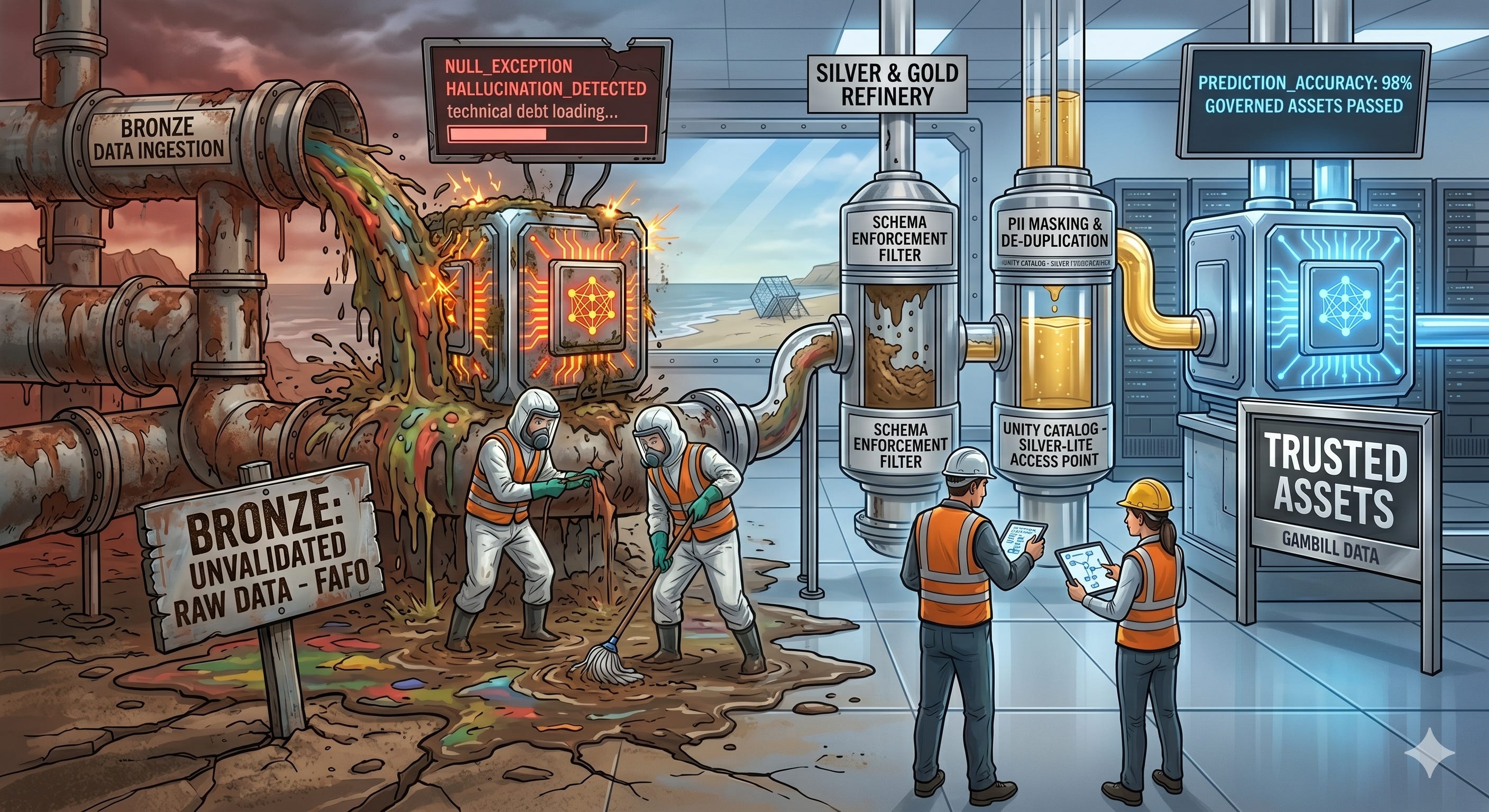
In the data engineering community, we call this the FAFO Phase of Data Architecture. And as a strategy lead, I am here to tell you that if you want to let analysis be done on your silver layer, I’m giving you that same waiver to sign that they give you before eating ghost peppers.
The Staging Fallacy: “Right?... Right?!”
Consider traditional software engineering. No sane Product Manager would ask a developer to deploy untested code directly from their local machine to a production server just to meet a deadline. Everyone respects the concept of a Staging environment. You validate, you test, and then you promote.
Depending on your architecture you might be familiar with staging tables. Would you let anyone do analysis, reporting, make decisions on that data?
NO!
Yet, when it comes to bronze data, people routinely ask to “just use that”. They want to let data scientists loose on raw, unvalidated data to build production-grade predictive models.
You would never let a team loose on your raw staging data... right? Right?!
To understand why this is a catastrophic idea, we have to look at the anatomy of the modern data stack. At Gambill Data, we architect solutions around the Databricks Lakehouse standard, utilizing the Medallion Architecture:
Bronze: The “As-Is” landing zone. It’s messy, it contains historical quirks, and it completely lacks schema enforcement.
Silver: The “Filtered and Cleaned” zone. This is where business logic, deduplication, and schema validation take shape.
Gold: The “Business Ready” zone. High-performance, aggregated, and ready for the C-Suite or production applications.
When you allow a product team (or any business partner) build ML models or reporting directly on Bronze data, you aren’t accelerating innovation. You are architecting technical debt and distrust into the very foundation of your data product.
Why “Direct-to-Bronze” is Product Suicide
Building predictive maintenance models on raw data introduces three critical vectors of risk:
1. The Upstream Domino Effect In the Bronze layer, schemas change without notice. An upstream software engineer renames a telemetry field in the source system from engine_temp_c to temp_celsius. Because Bronze lacks schema enforcement, the raw files just keep landing. Suddenly, your production “Predictive Maintenance” model isn’t predicting an engine failure—it’s throwing a NullPointerException and crashing the application.
2. The Ghost in the Machine Raw data is inherently noisy. It contains duplicates, late-arriving records, and artifacts from upstream system testing. If a machine learning model learns from this noise, its “predictions” are hallucinations. In a predictive maintenance context, training on unvalidated data means missing a critical hardware failure or triggering a costly, false-positive emergency shutdown.
3. The Compliance Breach Bronze often contains PII (Personally Identifiable Information) that hasn’t been masked or pseudonymized yet. Opening Bronze to a wider product team is frequently a direct violation of internal governance and external protocols like GDPR or CCPA.
The Gambill Pivot: Minimum Viable Silver
As data leaders, our job is to solve the business problem, which means a flat “No” is a failure of leadership. When a client asks for Bronze access to meet a deadline, we firmly redirect the risk.
We tell them: We can certainly grant access to a static, point-in-time export for exploratory analysis. However, we will not endorse or support a production-level ML model built on Bronze data. To do so would be to knowingly architect a system destined for failure.
Instead of waiting for a “Perfect Silver” layer to be completely finished, the strategy requires a Fast-Track Silver Sandbox.
The Refined Sandbox: We prioritize a “Silver-Lite” pipeline that applies basic schema enforcement, deduplication, and PII masking to only the specific fields the ML model requires.
Governed Access: Leveraging Unity Catalog on Databricks, we grant temporary, audited access to these specific, validated volumes without opening the floodgates to the entire raw lake. (Or, in Microsoft ecosystem integrations, ensuring Microsoft Fabric is governed with identical rigor).
This fulfills the business need for speed without sacrificing the integrity of the architecture.
Build Assets, Not Debt
At Gambill Data, our mantra is simple: We don’t just build pipelines; we build data assets that the business can trust. Speed without governance is just a faster way to make a million-dollar mistake. Data Scientists should not be expensive data cleaners, and production ML models should never rely on a foundation of wet sand. If your team is stuck in the Bronze layer, your data pipeline isn’t a pipeline—it’s a bottleneck.
Stop guessing. If your data science initiatives are stalling out on raw data, it is time to audit your architecture and establish clear rules of engagement. Reach out to Gambill Data, and let’s build a foundation you can scale on.