The 10-Year Junior
Escaping the Comfort Zone Career Trap

I’m currently coaching a student who has been in this industry for over twelve years. On paper, he’s a veteran. He’s survived migrations, handled high-priority outages, and has a resume that should command a top-tier salary.
But when we sat down to look at his readiness to move into a new company, the room went cold.
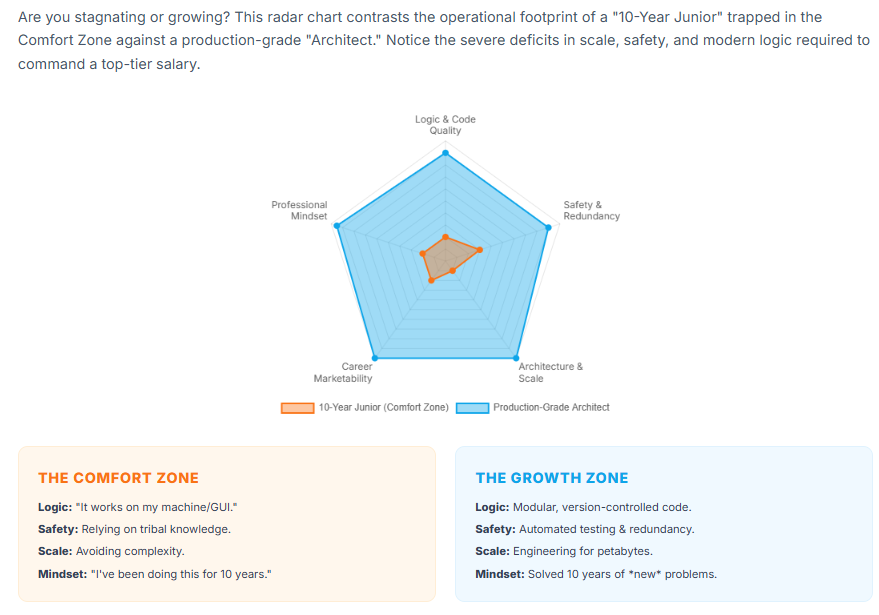
Despite his 10 + years in the seat, he’d never used Git. He’d never written a line of production-grade code. His entire career had been built inside a Comfort Zone… a world of drag-and-drop tools, tribal knowledge, and manual fixes. He wasn’t a Senior Engineer; he was a “10-Year Junior.” He had one year of experience, repeated twelve times.
If you are currently working in a shop where you are the “Oracle” (not that Oracle) who knows where all the bodies are buried, but you haven’t learned a new foundational skill in three years, you are in the Danger Zone.
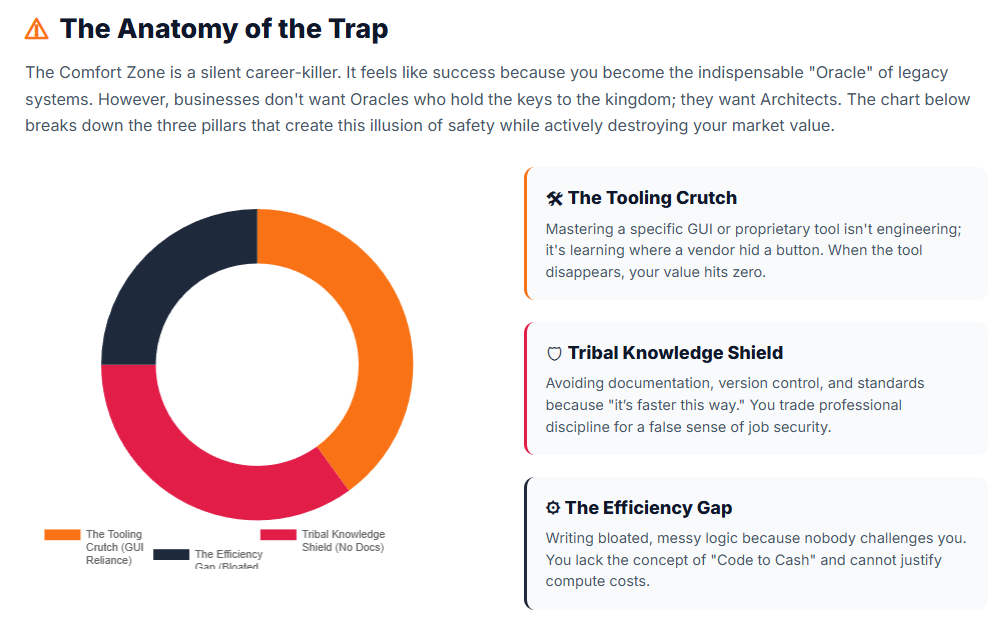
The Anatomy of the Trap
The Comfort Zone is a silent career-killer because it feels like success. You become indispensable to your current company because you’re the only one who can navigate the mess you helped create. This makes you feel safe.
It’s a lie. You aren’t indispensable; you’re un-hirable.
In a modern “Code to Cash” environment, businesses don’t want “Oracles” who hold the keys to the kingdom. They want Architects who build systems that can survive without them.
The Three Pillars of Stagnation:
The Tooling Crutch: You’ve mastered a specific GUI or a niche proprietary tool. You aren’t learning the craft of engineering; you’re learning where a vendor hid a button. If that tool disappears, so does your value.
The Tribal Knowledge Shield: You don’t document, you don’t use version control, and you don’t follow standards because “it’s faster this way.” You’ve traded professional discipline for a false sense of job security.
The Efficiency Gap: You write bloated, messy logic because nobody is there to challenge you. You have no concept of “Cost to Compute” because you’ve never had to justify a cloud bill to a CFO.
The Way Out: The “Discomfort Protocol”
You cannot “study” your way out of stagnation with a 15-minute YouTube tutorial. You have to break your own habits. This is the 90-day extraction plan to trade your tenure for actual expertise.
Step 1: Force the Discipline (Days 1–30)
You don’t need a manager’s permission to stop being a “Cowboy.”
Git is the Law: Download Git today. Even if you are the only person on your team, every script, query, and config file goes into a repository. Branch your features. Write commit messages that explain why, not just what. If it isn’t in Git, it didn’t happen.
The “Junior” Test: Take a piece of logic you wrote six months ago. If a Junior engineer can’t look at it and understand the flow in five minutes, it’s garbage. Restructure your SQL using CTEs. Use meaningful naming conventions. Stop writing “paragraphs” and start writing “architecture.”
Step 2: Kill the GUI (Days 31–60)
GUIs are for operators; code is for engineers.
Script the Automation: Whatever you’re currently doing via “Point-and-Click,” find a way to script it. Use Python to move a file. Use CLI tools to manage your database. The moment you move from a mouse to a terminal, your market value doubles.
Adopt dbt (Data Build Tool): Even if you aren’t using it at work, learn it. It forces you to treat SQL like software engineering, complete with testing, documentation, and versioning. It is the fastest bridge from the Comfort Zone to the Modern Stack.
Step 3: The “Code to Cash” Audit (Days 61–90)
Start thinking like a Hiring Manager who is looking for reasons to fire the “expensive guy.”
Cost Analysis: Analyze your most frequent pipeline. If this were running on a consumption-based model (Snowflake/Databricks), what would it cost? How much “technical debt” are you currently charging to the company’s credit card?
Failure Documentation: Stop fixing things in secret. Document every failure, the root cause, and how you’ve engineered the system to ensure that specific failure never happens again.
How to Prevent “Skill Rot” (The Anti-Fragility Playbook)
The Comfort Zone is like a riptide… if you stop swimming, it pulls you back out to sea.
The Two-Year Rule: If your daily tools and processes haven’t changed in 24 months, you aren’t “experienced.” You’re stagnant. Audit your stack. If you aren’t learning something that scares you, you’re in danger.
Seek the War Room: If you are the smartest person in your office, find a new office. You need to be in environments where “Senior” means more than just “has been here the longest.”
Validate Your Anxiety: That nagging feeling that you might not be able to pass a technical interview at a top-tier firm? Listen to it. That isn’t imposter syndrome; it’s your survival instinct telling you that your skills are devaluing.
The Verdict
The student I’m coaching is going to make it. Why? Because he had the humility to realize that his 12 years of tenure didn’t entitle him to a 12-year salary in a modern market.
He’s doing the work. He’s embracing the discomfort. He’s moving from an “Operator” to an “Engineer.”
The Comfort Zone is a career graveyard. If you want to survive, you have to be willing to kill your old self to build a better one. Stop being the “Oracle.” Start being the Architect.
If you’re a veteran engineer feeling the walls of the Comfort Zone closing in, don’t wait for a layoff to wake you up. Join the Gambill Data Coaching Program. We don’t do “Happy Paths.” We do Production-Grade reality.
Not ready to jump into the structured program? Join me for more insights on YouTube!
I have a pleasure now to interview data engineers and holy smokes, ppl working i.e. for many many years in one company (usually the big-4 kinda companies which is very interesting) don’t know things that other engs who are in the industry for 3-4 years but had three career changes know.
Feels like the syndrome of the professional imposter. A lot of knowledge but no real work to advance to a senior level. Leaving the comfort zone is the way. I’ve been there and thankfully 😅 it’s been a great journey now I can mix my experience with actually real work, using git, dbt and leaving a drag and drop application like ODI to Apache airflow for better flexibility in integration with other data sources, but always guaranteeing business continuity.